

Table of Contents
- Why Shipping Rare Collectibles Requires Special Care
- Best Packaging Materials for Fragile Items
- How to Pack Pop Vinyls for Shipping
- Handling Specific Collectibles: Comics, Records, and Coins
- Transit Insurance for Collectibles
- Selecting the Right Shipping Carrier and Tracking
- Sustainable Packing for High-Value Goods
- The Double-Box Method and Advanced Protection
- Frequently Asked Questions
Last Updated: September 21, 2026
Why Shipping Rare Collectibles Requires Special Care
Rare collectibles aren't like standard parcels. A Pop! Vinyl figure worth several hundred dollars, a graded comic book, or a limited-edition die-cast model demands protection that goes beyond standard packaging. When you ship rare collectibles, you're protecting not just an object, you're protecting the collector's investment, their passion, and often years of searching to complete a set.
The stakes are genuinely high. A damaged limited-edition figure can lose 40-60% of its resale value. A moisture-damaged comic book becomes worthless. A scratched record loses its collectibility entirely. This is why the best ways to ship rare collectibles involves multiple layers of protection, proper documentation, and carriers that understand what they're handling.
At Pop Pelican, we've learned what separates safe arrivals from costly disasters. The difference comes down to understanding your item's vulnerabilities, whether that's shock sensitivity, moisture exposure, or pressure damage, and building a shipping strategy that addresses each one.
Best Packaging Materials for Fragile Items
Fragile collectibles need multiple protective layers. Think of it as building a shock-absorbing fortress around your item. The goal isn't just to prevent damage, it's to absorb impact energy so the item inside never feels the force of a drop or collision.
Double-Wall Boxes and Rigid Protection
Double-wall boxes are non-negotiable for high-value items. A single-wall box flexes under pressure and offers minimal shock absorption. Double-wall construction creates a rigid structure that distributes impact forces across a larger area, protecting contents from concentrated shock.
For truly valuable collectibles, rigid protection goes beyond the box itself. Acid-free backing boards for comics, rigid acrylic cases for Pop! Vinyls, and custom-fitted foam inserts all serve the same purpose: preventing movement inside the package. When your item can't shift, it can't collide with the box walls during transit.
Pop Pelican's Star Wars Clone Wars Rex Limited Edition comes pre-packaged in a UV Premium Plastic POP! Protector specifically designed to prevent damage during shipping. This is the standard you should match for any rare item, protection built into the packaging itself, not added as an afterthought.

Void Fill and Cushioning Techniques
Void fill is the space between your item and the box walls. Empty space is your enemy. Every gap is an opportunity for movement, and movement causes damage. Your goal is to fill every void with cushioning material that absorbs shock without compressing too much.
Bubble wrap remains the industry standard for collectibles. The air pockets absorb impact energy, and the plastic layer prevents moisture from reaching your item. For maximum protection, use multiple layers, typically 3-5 wraps around delicate items. Avoid packing peanuts for high-value goods; they shift during transit and leave gaps.
For items sensitive to pressure, use foam sheets or air pillows instead of bubble wrap alone. These materials compress gradually rather than suddenly, protecting items like vinyl records that can crack under concentrated pressure. The key is matching your cushioning material to your item's specific vulnerability.
How to Pack Pop Vinyls for Shipping
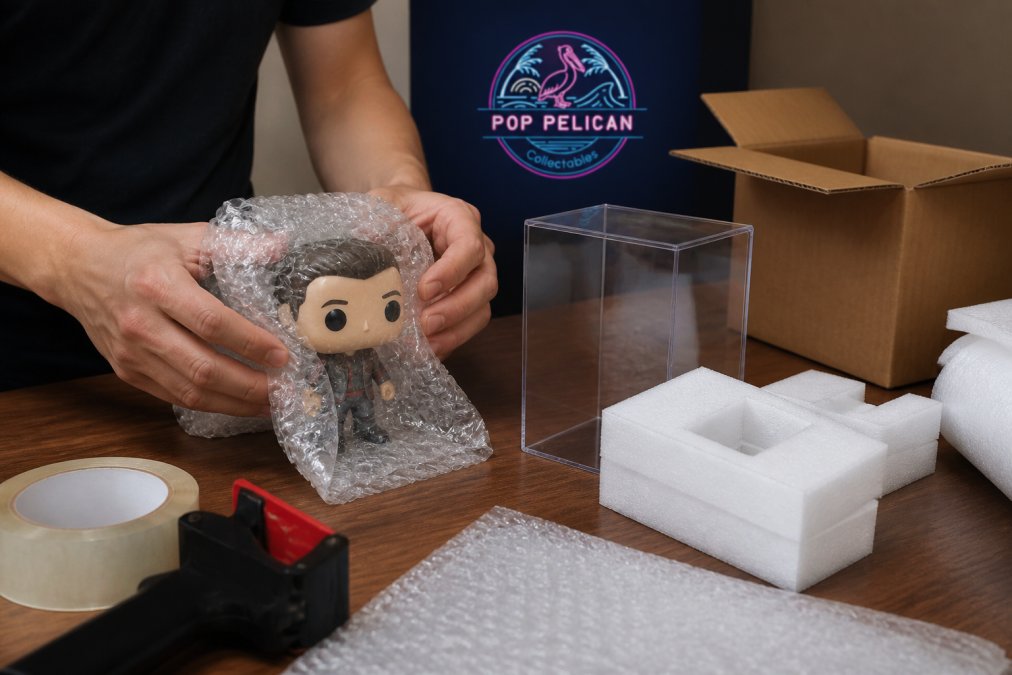
Pop! Vinyls are deceptively fragile. The vinyl material is rigid but brittle, a sharp impact can crack or chip the figure. The paint is applied directly to the vinyl surface, so any scratch or dent becomes permanent damage. The base is often the weakest point, prone to breaking if the figure tips inside the box.
Securing Bases and Protecting Vinyl Surfaces
Start by securing the base. Many collectors use museum-quality adhesive or removable museum putty to fix the figure to its base, preventing any rocking or shifting. If the base is damaged or missing, replacement bases are essential, the Funko Pop! Stand Bases 10-pack from Pop Pelican provides high-quality replacement bases in multiple styles, starting at just $12.95.

Wrap the figure in acid-free tissue first. This creates a barrier between the vinyl and any moisture or chemical residue from packing materials. Then apply bubble wrap, starting from the base and working upward. Wrap tightly enough that the figure can't move, but not so tightly that you're applying pressure to the vinyl itself.
The acrylic protector is your next layer. A clear acrylic case keeps the figure isolated from direct contact with cushioning materials and protects against dust and moisture during transit.
Archival-Safe Storage and Packing Methods
Archival-safe materials matter because standard packaging contains acids and lignin that degrade collectibles over time.
Use acid-free boxes, acid-free tissue, and archival-quality bubble wrap when available.
Store packed items in a cool, dry location before shipping. Temperature fluctuations and humidity create condensation inside the box, which can damage vinyl and paint. If you're packing during humid weather, include a small silica gel packet inside the inner wrapping to absorb moisture.
Funko - Pop! Stand Bases 10-pack →
Handling Specific Collectibles: Comics, Records, and Coins
Different collectibles have different vulnerabilities. Comics are destroyed by moisture and creasing. Records crack under pressure. Coins are damaged by fingerprints and oxidation. Each requires a tailored approach.
For comics, use rigid backing boards and top loaders (plastic sleeves that hold the comic flat). Double-box the package with the comic positioned between foam sheets so it can't shift.
For records, use rigid LP mailers with foam padding inside.
Transit Insurance for Collectibles
Insurance is non-negotiable for high-value shipments. A damaged item worth $500 with no insurance becomes a total loss. With proper insurance, you recover the item's value and can replace it.
Valuation and Documentation Requirements
Declare the full replacement value of your item, not what you paid for it. A rare limited-edition Pop! Vinyl might have cost $30 at retail five years ago but now sells for $300. Insure it at current market value.
International Customs and Duty Documentation
Shipping rare collectibles internationally requires customs declarations. You must accurately describe the item and declare its value. Undervaluing items to avoid duties is illegal and voids your insurance if the parcel is lost or damaged.
Selecting the Right Shipping Carrier and Tracking
Not all couriers treat fragile items equally. Some carriers have better track records with collectibles than others. Your choice of carrier directly impacts the likelihood of safe delivery.
Digital Tracking and Proof-of-Delivery Protocols
Choose carriers that offer real-time tracking and signature confirmation for high-value items. Signature confirmation ensures someone accountable receives the parcel, it can't be left unattended where it might be exposed to weather or theft.
Climate-Controlled Shipping Options
For extremely valuable or sensitive items, climate-controlled shipping is available through premium courier services. These options maintain stable temperature and humidity throughout transit, preventing the condensation and temperature fluctuations that damage collectibles.
Sustainable Packing for High-Value Goods
Protecting your collectible doesn't require single-use plastics and wasteful materials. Sustainable packing methods work just as well while reducing environmental impact.
The Double-Box Method and Advanced Protection
The double-box method is the gold standard for rare collectibles. It involves packing your item in an inner box, then placing that box inside a larger outer box with cushioning material between them. This creates two layers of shock absorption.
| Step | Purpose | Result |
|---|---|---|
| Inner box packing | Secure item, prevent movement | Item isolated from direct impact |
| Sealed inner box | Create rigid unit | Protects against crushing |
| Outer box with gap | Absorb shock energy | Impact force dissipated before reaching inner box |
| Secure outer box | Prevent shifting during transit | Double-box system stays intact |
Frequently Asked Questions
What is the best way to pack fragile collectibles for shipping?
Use a double-box method with at least 5 centimetres of void fill between layers. Wrap each item individually in bubble wrap or archival-safe tissue, place it in a rigid inner box with cushioning, then nest that box inside a larger outer box filled with additional shock-absorbing material. Secure all layers with tamper-evident tape and include a fragile sticker on the shipping label for carrier awareness.
Do I need transit insurance for high-value collectibles?
Yes, transit insurance is essential for rare items. Declare the full valuation with your shipping carrier and consider specialist collectibles insurance. Document condition with photos before shipping, obtain a tracking number with signature confirmation, and keep proof of delivery.
What are the best materials for protecting rare Pop! Vinyls during transit?
Pop! Vinyls benefit from multiple protective layers: acrylic or UV-protective cases for the figure itself, bubble wrap for cushioning, and void fill such as foam peanuts or crinkled paper inside the box. The Funko Pop! Stand Bases 10-pack ($12.95) ensures figures remain stable during transit. Avoid direct contact between the vinyl and cardboard to prevent moisture absorption.
How should I document the condition of a collectible before shipping?
Take clear photographs from multiple angles under natural light, capturing any visible wear, printing defects, or packaging condition. Create a detailed written inventory noting the item's edition number, rarity status, and estimated value. Store this documentation digitally and keep printed copies with your shipping records. This evidence protects you in disputes and supports insurance claims if damage occurs.
What labelling and customs requirements apply to collectibles shipped internationally?
International shipments require a completed customs declaration form detailing the item's description, declared value, and country of origin. Mark the parcel clearly with the destination country and include a tracking number. For high-value collectibles, use signature confirmation and consider climate-controlled shipping options. Ensure all documentation matches the item's actual value to avoid customs delays or penalties.
How do I choose the right courier for rare items?
Select a carrier offering signature confirmation, real-time tracking, and proof-of-delivery protocols. Check whether they provide specialist handling for fragile goods and whether they offer transit insurance options. Compare their dimensional weight policies, as collectibles packaging can increase dimensional weight charges. Verify that your chosen carrier covers your item's declared value and offers liability protection for high-value goods.


