

Table of Contents
- Where to Buy Authentic Die Cast Models: What Serious Collectors Check First
- Quick Comparison: 10 Authentic Die Cast Models Worth Buying
- How to Spot Fake Diecast Models Before You Pay
- Best Diecast Model Brands and What Each One Does Well
- Protecting Rare Diecast Collections: Storage, Display and Handling
- Grading and Condition Standards: What Makes a Model Collector Grade
- Why Authentic Die Cast Models Hold Their Value
- Conclusion: Building a Collection You Can Trust
- Frequently Asked Questions
Last Updated: October 7, 2026
Where to Buy Authentic Die Cast Models: What Serious Collectors Check First
Finding where to buy authentic die cast models starts with one rule: buy from a specialist retailer that stocks officially licensed stock and can trace every item back to the manufacturer. At Pop Pelican, we have spent over 20 years helping collectors avoid counterfeits, and the difference between a genuine model and a fake usually comes down to who you buy from, not how much you pay.
A die cast model car is a scale replica manufactured by pouring molten metal alloy into a mould, then finishing it with paint, decals and moving parts. Authentic versions carry an official licence from the car maker. Fakes rarely do.
That distinction matters more than most buyers realise. Counterfeiters have become skilled at copying box art and logos, so the warning signs now sit in the fine print and the finish rather than the packaging alone. Below, we break down exactly what to check before you pay, which brands earn their reputation, and how to keep a collection in collector grade condition for years.
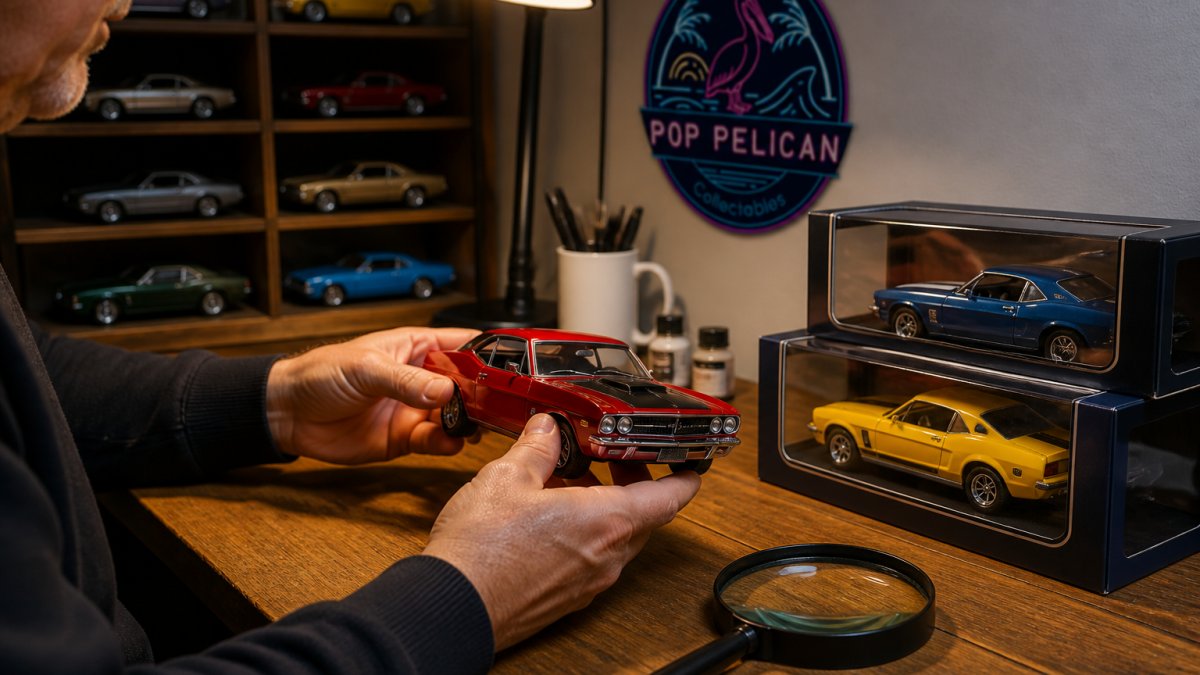
Quick Comparison: 10 Authentic Die Cast Models Worth Buying
| Model | Scale | Price | Best For |
|---|---|---|---|
| HyperSpec Porsche 911 GT3 RS (992) Gloss Black | 1:24 | $39.95 | Modern supercar fans |
| Solido RWB Bodykit Cinderella Yellow 2020 | 1:18 | $89.95 | Display centrepieces |
| Timeless Legends 1970 Ford Mustang Boss 429 | 1:24 | $39.95 | Classic muscle collectors |
| Pink Slips Porsche Carrera GT | 1:24 | $44.95 | Bold colour schemes |
| JDM Tuners 2003 Nissan 350Z | 1:24 | $39.95 | Japanese car enthusiasts |
| JDM Tuners 2002 Honda NSX Type-R | 1:24 | $39.95 | JDM purists |
| JDM Tuners 1993 Mazda RX-7 | 1:24 | $39.95 | Rotary fans |
| JDM Tuners 2016 Subaru WRX STi Candy Blue | 1:24 | $39.95 | Rally heritage |
| Big Time Muscle 2024 Ford Mustang Dark Horse | 1:24 | $39.95 | New-release buyers |
| HyperSpec Lykan Hypersport Copper | 1:24 | $34.95 | Exotic car collectors |
Every model above is officially licensed and available now. Prices sit between $34.95 and $89.95.

How to Spot Fake Diecast Models Before You Pay
The fastest way to spot a fake is to check the licensing text and the base plate. Genuine models print the manufacturer's name, the car brand's official trademark and a licence reference somewhere on the packaging or the underside of the chassis. Counterfeits often skip this entirely, or print it in a font that looks slightly off.
Packaging, Logos and the Details Counterfeiters Get Wrong
Look closely at the box before you look at the car. Fakes tend to fail on the small things:
- Blurry or pixelated brand logos on the box art
- Misspelled manufacturer names or missing trademark symbols
- Cheap cardboard that flexes easily, with no inner protective tray
- No licence reference number anywhere on the packaging
- Paint that feels tacky or smells strongly of solvent
If you are buying in person, run a fingernail gently along a decal edge. Genuine decals sit flush under a clear coat. Fakes lift or peel.
Best Diecast Model Brands and What Each One Does Well
Brand reputation is the quickest authenticity filter you have. A licensed brand pays for the right to reproduce a car maker's trademarks, and that licence obligation shapes everything from the casting accuracy to the box printing. An unlicensed brand has no such obligation, which is why fakes cluster around popular models and rarely bother with obscure ones.
Here is how the main lines differ, and what each one is actually good at.
- HyperSpec, exotic and high-performance cars with opening doors, detailed interiors and multi-stage paint. Best for collectors who want a display piece rather than a toy.
- JDM Tuners, Japanese legends including the Nissan 350Z, Honda NSX Type-R and Mazda RX-7. Castings lean toward accurate body proportions and period-correct wheels.
- Big Time Muscle, American muscle, including the 2024 Ford Mustang Dark Horse. Heavier castings and broader stance than the JDM line.
- Pink Slips, bold colour schemes and premium rubber tyres at 1:24. Aimed at collectors who display models out of the box.
- Solido, European classics and modern performance cars at 1:18, with finer interior detail and more accurate panel gaps than most 1:24 equivalents.
Scale, Casting Quality and Paint Finish: What Sets Brands Apart
Scale determines how much detail a model can carry. A 1:18 model is roughly twice the length of a 1:24, which allows finer interior work, more accurate panel gaps and separate chrome trim rather than painted-on highlights. The trade-off is price and shelf space: a 1:18 needs about 30 cm of display width, so a shelf that holds twenty 1:24 models will hold around eight 1:18s.

Casting quality shows in the panel lines. Run your eye along a door seam on a good model and it stays even. On a poor casting it wanders or sits too deep. Paint finish is the other giveaway: licensed models typically use multiple coats with a consistent gloss, while unlicensed copies often show orange-peel texture, thin patches near the edges, or a slightly different shade between the body and the doors.
How to Tell a Licensed Brand from an Unlicensed One
Licensing leaves a paper trail. Licensed brands publish which car makers they hold agreements with, and their packaging carries the trademark symbol next to the car brand's name. Unlicensed producers tend to avoid naming the manufacturer on the box, or use a slightly altered name, 'Mustang-style' rather than 'Ford Mustang', for example.
A second signal is catalogue consistency. Licensed brands release models in waves tied to real production cars and announce them in advance. Unlicensed producers churn out whatever is currently popular, often in colours the real car was never offered in. If a model exists in a colourway you cannot find on the manufacturer's own website, treat it as a warning sign rather than a rare find.
HyperSpec - 1:24 Porsche 911 GT3 RS (992) (Gloss Black) Diecast Vehicle →
Protecting Rare Diecast Collections: Storage, Display and Handling
Protecting rare diecast collections comes down to three things: stable temperature, low humidity and minimal handling. Metal expands and contracts with heat, which stresses paint and decals over time. A room that stays between 18 and 22 degrees Celsius with moderate humidity is ideal.
For display, sealed cabinets beat open shelving. Dust is abrasive, and every wipe risks scratching a decal. If you handle a model, hold it by the base or the wheels, never the body.
- Use acid-free tissue or the original inner tray for storage
- Keep models out of garages and sheds where humidity swings
- Avoid stacking boxes more than three high
- Dust with a soft brush, not a cloth
- Rotate display pieces rather than leaving one in direct light
Grading and Condition Standards: What Makes a Model Collector Grade
A model reaches collector grade when it is complete, undamaged and, ideally, still in its original packaging. Collectors generally assess four areas: the paint, the decals, the moving parts and the box.
Paint should be free of chips, runs and fading. Decals should sit flat with no lifting. Doors, bonnets and boots should open and close without catching. The box matters more than beginners expect: a mint box can lift a model's value well above an identical loose example.
| Grade | Condition | Typical Signs |
|---|---|---|
| Mint in box | Unopened, perfect | Sealed packaging, no shelf wear |
| Excellent | Opened, flawless model | No paint chips, box intact |
| Good | Minor wear | Small decal lift, light box scuffs |
| Fair | Visible damage | Paint chips, loose parts, torn box |
Why Authentic Die Cast Models Hold Their Value
Authenticity is the single biggest factor in whether a die cast model holds value. Officially licensed models from recognised brands keep a resale market because buyers know exactly what they are getting. Unlicensed copies have no collector demand at all, no matter how good they look.
Limited production runs and discontinued castings also drive value. When a manufacturer stops producing a particular car, existing stock becomes harder to find, and prices firm up. This is why buying from a retailer with genuine stock availability matters: you are not just getting a model, you are getting one that can be traced and verified later.
For anyone weighing up ACCC guidance on consumer guarantees, buying from a local retailer also means your rights are protected if an item arrives damaged or misdescribed. That protection rarely extends to overseas marketplace sellers.
Conclusion: Building a Collection You Can Trust
Building a collection you can trust comes down to buying from sellers who can prove authenticity, then storing what you buy with care. Pop Pelican stocks officially licensed die cast models with same day shipping on 99% of orders, live courier tracking, and a team that answers email and phone queries directly. Browse our die cast range and start your collection with stock you can verify.
Frequently Asked Questions
How can you tell if a diecast model is authentic?
Check three things: the manufacturer's logo and licensing text on the packaging, the paint finish and panel gaps on the model itself, and whether the seller lists the item as an official licensed product. Authentic die cast models carry accurate branding, consistent paint, and tight casting quality. If the price is far below what every other seller charges, or the box art looks blurry, treat it as a warning sign and ask the seller directly about authenticity before buying.
What should I look for when buying diecast models online?
Look for clear product photos, the exact scale listed (1:18, 1:24, 1:43 or 1:64), and confirmation the item is officially licensed. Check whether the seller shows stock availability in real time rather than listing items that are backordered. Read the shipping and returns policy, especially for limited edition or pre-order items. A seller who answers questions about packaging integrity and shipping insurance before you buy is usually a safer bet than one who does not.
Are there reputable retailers for diecast cars in the local market?
Yes. Look for retailers that stock officially licensed products, list real-time in-stock inventory, and offer fast local shipping with tracking. Pop Pelican, for example, carries diecast models from $34.95, ships same day for 99% of orders, and backs every item as officially licensed. Local retailers also make returns and replacements simpler if a model arrives with damaged packaging, which matters more for collector grade items than for open-box purchases.
Which diecast brands are known for high investment value?
Brands that produce limited edition runs and resin models in 1:18 scale tend to hold value best, particularly when the original packaging stays intact. Solido, for instance, produces detailed 1:18 scale models like the RWB Bodykit Cinderella, priced at $89.95. Investment potential depends on scarcity, condition and demand for the specific casting. Models kept in their original box, away from direct sunlight and humidity, retain far more value than displayed loose models.
How do I protect rare diecast collections from damage?
Keep models out of direct sunlight to prevent paint fade, store them in display cases or original packaging to limit dust and handling marks, and avoid humid areas where die-cast metal can corrode. Handle models by the body rather than moving parts like doors or spoilers. For high-value pieces, keep the original box and any certificates. Regular dusting with a soft brush prevents buildup in panel gaps and around detailing without risking scratches.


