

Table of Contents
- Are Loungefly Bags Officially Licensed? The Short Answer
- How Loungefly Licensing Agreements Actually Work
- How to Spot Fake Loungefly Bags: A Visual Authentication Checklist
- Authorized Loungefly Retailers List: How to Verify a Seller
- The Legal Implications of Counterfeit Loungefly Merchandise
- Why Premium Quality and Craftsmanship Matter in Loungefly Bags
- Where to Buy Authentic Loungefly Bags with Confidence
- Frequently Asked Questions
Last Updated: September 25, 2026
Are Loungefly Bags Officially Licensed? The Short Answer
Yes. Loungefly bags are officially licensed merchandise, produced under formal agreements with the studios and brands that own the characters they feature. At Pop Pelican, we have over 20 years of industry experience, offering an extensive range of officially licensed Pop! Vinyls, action figures, Loungefly bags, and die-cast models.
How Loungefly Licensing Agreements Actually Work
An officially licensed product is made with written permission from the intellectual property owner, who approves the design, materials and quality control before anything reaches a shelf.
What Officially Licensed Means for Merchandise
Officially licensed means the manufacturer has a legal agreement with the trademark holder to produce goods bearing that trademark, covering specific characters, product categories and usually a defined territory and time period.
Why Licensing Protects Collectors and Designers
Licensing protects two groups at once. Designers and studios keep control of how their characters appear, and collectors get a product that holds its value because it is verifiably part of an official release.
How to Spot Fake Loungefly Bags: A Visual Authentication Checklist
The fastest way to spot a fake Loungefly bag is to inspect the stitching, hardware and interior tag before you pay. Counterfeits usually fail at least two of those three checks. Here is our checklist.
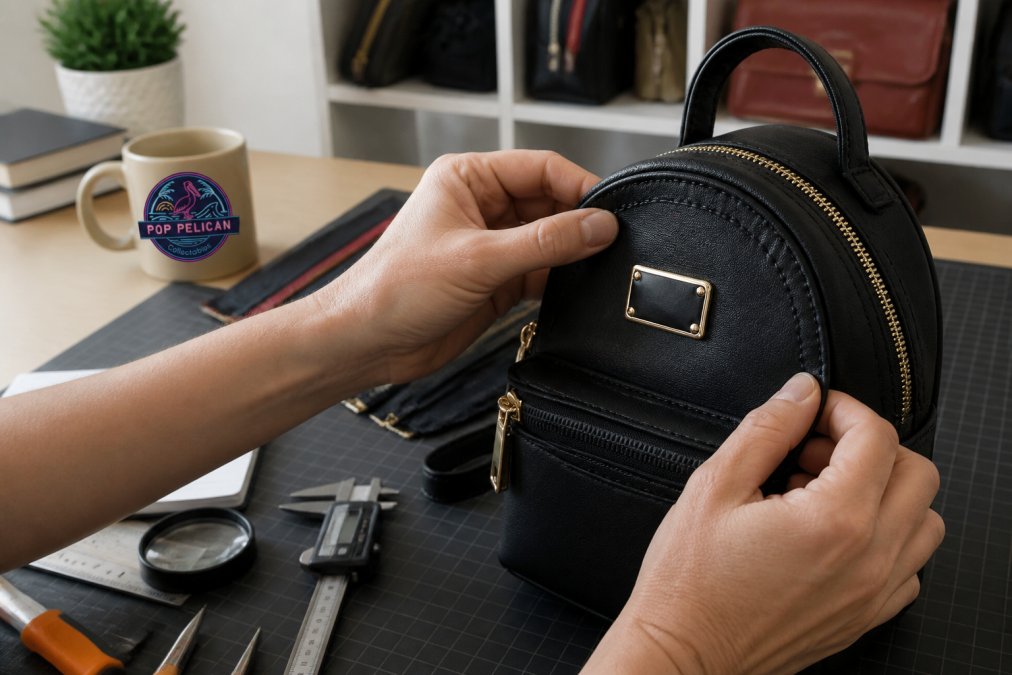
- Stitching: Even, tight and consistent along every seam, with no loose threads or skipped sections
- Hardware: Metal zipper pulls and rivets feel solid, not lightweight or coated plastic
- Zipper action: Glides smoothly with no catching or grinding
- Enamel charm: Present on models that include one, with clean edges and correct artwork
- Interior lining: Coordinating print that matches the bag's theme, not a plain generic fabric
- Tag: Loungefly branding printed cleanly, with no spelling errors or blurred logos
- Serial or style number: Present and legible on the interior tag
- Overall finish: No chemical smell, no glue residue, no misaligned applique
Stitching, Hardware, and Rivets: What Genuine Bags Get Right
Genuine bags use consistent thread tension, so seams look uniform from the front pocket to the shoulder straps. Imitations cut corners here first, because stitching is the slowest part of production to get right.
Tags, Serial Numbers, and Lining Checks
The interior tag is the single most useful authentication point. A genuine tag is printed cleanly, sits flat against the lining, and carries a style or serial number you can cross-reference against the product listing.
Authorized Loungefly Retailers List: How to Verify a Seller
There is no single public register of authorised Loungefly retailers, so verification comes down to evidence: a legitimate seller can show where the stock came from and stands behind it with a returns policy. The harder problem is the secondary market, where most counterfeit losses happen.
What Retailer Certification Looks Like
Certified retailers buy through official distribution channels, list products with accurate names and style numbers, and publish clear contact details. Look for a physical business presence, a real returns process and a reachable support team.
Verifying Sellers on the Secondary Market
On resale platforms, apply a stricter standard than in a shop: the seller is not the brand, so you can only verify their behaviour and evidence. Work through this sequence before you commit.
- Ask for the interior tag and serial number first. Request a photo of the tag inside the bag, not just the exterior. A genuine seller can take it in minutes; a counterfeit seller will stall, send a stock image, or claim the tag is 'hard to photograph'.
- Request a timestamped photo. Ask the seller to place a handwritten note with today's date next to the bag and photograph both together. This defeats recycled listing images pulled from another seller or a catalogue.
- Check the seller's history, not just their rating. Look for a pattern of collector-to-collector sales and whether past listings match the brands they claim to stock. A brand-new account selling a rare release below market is the most common counterfeit pattern.
- Read the platform's buyer protection terms before you pay. Most resale platforms only cover you if you pay and communicate inside their system. If a seller asks you to move to a bank transfer, a messaging app or a 'friends and family' payment, you have given up your dispute rights, walk away.
- Confirm the return address and policy in writing. A genuine seller will state, in the listing or in messages, that returns are accepted if the item is not as described. If the listing is silent on returns, ask directly and keep the reply.
- Cross-check the style number against the official listing. Search the style or serial number from the interior tag and confirm the bag, colourway and release match what the seller is showing. A number that returns no results, or a different design, is a red flag.
Red Flags That Should End the Conversation
- A price far below every other listing for the same release, with no explanation
- Reluctance to send additional photos, especially of the interior tag
- A seller who pressures you to pay quickly or outside the platform
- Listings that reuse the same photos across multiple items
- A seller who cannot say where they originally bought the bag
If a seller resists any of those requests, treat it as a no. Genuine sellers expect the question, and the ones who answer clearly are worth buying from.
A Note on 'Authorised' Claims
Some resellers call themselves 'authorised' without any agreement from the brand. Unless a seller can name the distributor or wholesale channel they buy through, treat 'authorised' as marketing. The evidence that matters is the supply chain, the returns policy and the seller's willingness to answer questions in writing.
Disney – Cinderella Cosplay Loungefly →
The Legal Implications of Counterfeit Loungefly Merchandise
Selling counterfeit merchandise is illegal, and the law treats it as more than a quality problem. In Australia, selling goods bearing a counterfeit trademark can breach the Trade Marks Act 1995, which lets the trademark owner stop unauthorised use of their mark and seek remedies. Separately, the Australian Consumer Law prohibits misleading conduct about the origin and authenticity of goods, the provision that most directly protects a buyer sold a fake described as genuine.
What the Two Regimes Actually Cover
The Trade Marks Act protects the brand owner: it is how a studio or licensee pursues a counterfeiter, and it can lead to injunctions, damages and, in serious cases, criminal penalties. The Australian Consumer Law protects the buyer: it is the mechanism you use if a seller misrepresented a counterfeit as authentic, because the item does not match its description.
Your Rights as a Buyer
If you are sold a counterfeit described as genuine, you may be entitled to a remedy under Australian Consumer Law, because the product does not match its description. The ACCC guidance on consumer guarantees sets out how those guarantees apply to online purchases, including purchases from overseas sellers. In practice, the remedy is usually a refund or replacement, and the claim runs against the seller, which is why buying from a seller you can actually reach is worth more than a low price.
Why Enforcement Is Harder Than It Looks
Counterfeit supply chains are deliberately fragmented: a single bag may pass through a manufacturer, exporter, wholesale marketplace and reseller, each a different legal entity in a different jurisdiction. That is why enforcement focuses on the largest, most visible sellers rather than every listing.
What This Means Before You Buy
The legal risk sits with the seller, but the financial loss usually sits with the buyer, which is why authentication before purchase matters more than any remedy afterwards. IP Australia notes that counterfeiting harms both brand owners and consumers, the brand loses control of its reputation, and the buyer loses money on an item that will never hold value with the collector community.
A Practical Rule
If a deal looks too good, ask why. A genuine, licensed Loungefly bag carries a real cost, approved artwork, tested materials, quality control and a manufacturer accountable to the brand owner. A price that ignores all of that is telling you something the listing does not.
Why Premium Quality and Craftsmanship Matter in Loungefly Bags
Premium quality shows up in specific construction choices. Loungefly mini backpacks typically use faux leather (polyurethane) with applique, debossed, embroidered and printed detailing, plus a coordinating interior lining and enamel zipper charms.
Where to Buy Authentic Loungefly Bags with Confidence
Buying authentic comes down to buying from a source that can prove its supply chain: a retailer with a physical presence, accurate product listings and a returns policy covering damaged or misdescribed items.
| What You Are Checking | Genuine Bag | Counterfeit |
|---|---|---|
| Stitching | Even, tight, consistent | Loose or skipped |
| Hardware | Solid metal, clean plating | Hollow, flaking |
| Interior lining | Coordinating themed print | Plain or mismatched |
| Interior tag | Clean print, serial number | Blurred, missing number |
| Zipper action | Smooth glide | Catching or grinding |
| Price | Matches retail listings | Suspiciously low |
Frequently Asked Questions
Are all Loungefly bags officially licensed products?
Yes. Loungefly produces officially licensed merchandise through formal agreements with brands like Disney, Marvel, and Star Wars. Every genuine Loungefly bag carries artwork and characters used under a legal licensing agreement. If a bag features a recognisable character or franchise logo but has no licensing information on its tags, that is a strong warning sign it may be counterfeit rather than an officially licensed product.
Are there fake Loungefly backpacks on the market?
Counterfeit Loungefly bags do exist, particularly on the secondary market and through unverified social media sellers. Common signs include uneven stitching, flimsy hardware, misspelled branding, and missing serial numbers or tag verification details. Buying from a verified seller or an authorized retailer dramatically reduces your risk. If a price seems far below the usual retail range for a mini backpack, treat it as a red flag and check the seller's credentials first.
Why is it important to buy from authorised Loungefly retailers?
Authorized retailers source stock directly through official distribution channels, so every bag is guaranteed authentic and covered by consumer protections. When you buy from a verified seller, you also get accurate product descriptions, proper returns policies, and support if something goes wrong. Purchasing from unauthorized sellers or the secondary market means you carry the full risk of receiving a counterfeit or damaged item with no recourse.
What should I look for in the hardware of a genuine Loungefly bag?
Genuine Loungefly bags use sturdy metal hardware with clean, even finishes. Zippers run smoothly, enamel zipper charms are securely attached, and rivets sit flush against the material. On counterfeits, hardware often feels lightweight, shows rough edges or bubbling, and zippers catch or stick. Check the top handle and adjustable shoulder straps too, since these stress points reveal quality differences between authentic craftsmanship and mass-produced imitation bags.


