

Table of Contents
- Step 1: Run a Funko Pop Serial Number Check
- Step 2: Inspect the Box Quality and Production Sticker
- Step 3: Analyse Paint Application and Colour Saturation
- Step 4: Verify the Logo, Font Alignment, and Base Stamp
- Step 5: Check Weight, Material Density, and Seam Lines
- Common Signs of Fake Pop Vinyls Every Collector Should Know
- Buying Authentic Pop Vinyls Online: Safety Protocols for the Secondary Market
- Frequently Asked Questions
Last Updated: September 25, 2026
Step 1: Run a Funko Pop Serial Number Check
Learning how to spot fake pop vinyls starts with the production code. Every genuine figure carries a stamped or printed code on its base and a matching code on the box, and counterfeiters rarely replicate both correctly. At Pop Pelican, we have handled thousands of officially licensed figures over 20 years, and the serial number is a fast test.
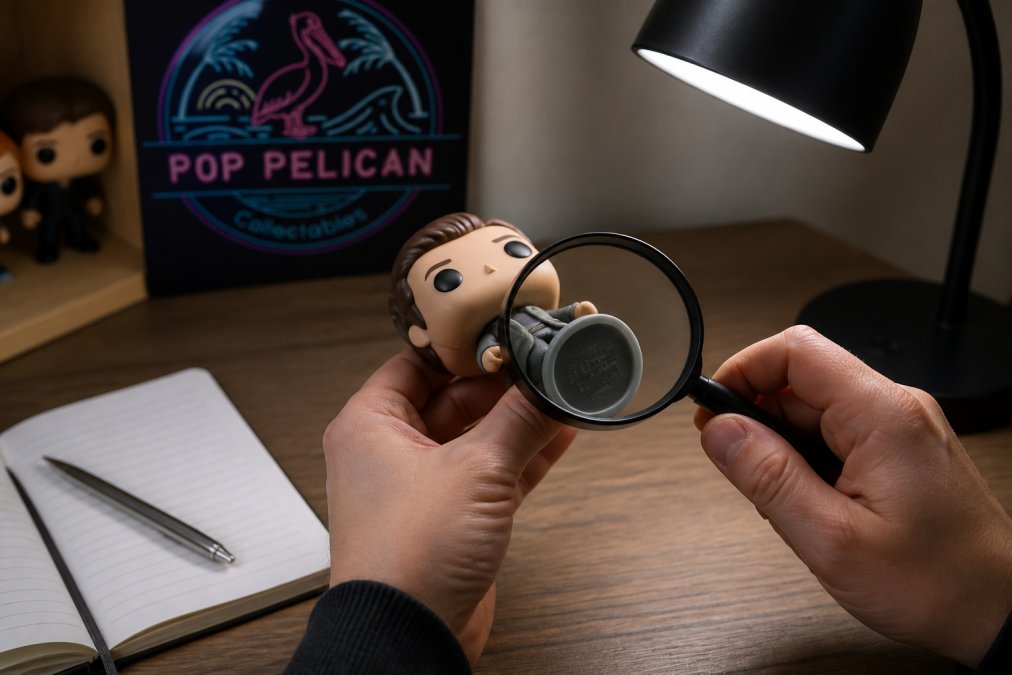
Where to Find the Serial Code on Your Figure
Genuine Pop! Vinyls carry a production code in two spots: stamped into the base of the figure (usually under the feet or on the underside of the stand) and printed on the bottom of the window box. The two codes should match.
- Check the base stamp under the figure's feet or on the stand
- Look for a printed production code on the box underside, near the barcode
- Compare both codes side by side
- Match the code to the official release year and line
Reading the Code: What the Numbers Actually Mean
A genuine production code is not random. It typically encodes the factory, the production run, and the date. Collectors commonly find that the box code and the figure stamp share the same batch identifier, even when the printed layout differs slightly between releases.
A practical pattern to check:
- The last digits of the box code and the base stamp should align with the same production window
- The release year on the box should not predate the production code by an implausible margin
- The code should be consistent with the line named on the box (for example, a Pop! Movies release should not carry a code pattern associated with a different line)
Using the Official Funko App vs. Manual Code Verification
The official Funko app lets you scan a barcode and pull up release details in seconds. Manual checking works just as well if you know what to look for.
- App method: scan the barcode, then compare the listed release date and line to your box art
- Manual method: type the serial code into a search engine and cross-check the results against the figure in your hand
Macro Photography: The Serial Check Competitors Skip
Most guides tell you to compare codes but never show you how. The single most useful technique is a macro comparison: photograph the base stamp and the box code under the same light, at the same angle, and at the same magnification, then place the images side by side.
What to look for in the comparison:
- Stamp depth: genuine stamps are usually crisp and evenly pressed; fakes are often shallow or double-struck
- Font weight: the lettering on a genuine stamp is consistent; fakes show thicker or thinner strokes in the same code
- Ink and print quality: box codes on genuine packaging are sharp; counterfeit codes are often slightly fuzzy or misaligned
- Spacing: the gap between characters on a genuine code is even; fakes show crowding or drift
Step 2: Inspect the Box Quality and Production Sticker
Box quality separates genuine figures from counterfeits faster than almost anything else. Real Funko packaging uses thick card stock with clean edges and sharp printing. Fakes cut corners on materials, and it shows the moment you pick the box up.
Barcode Scanning and Window Box Integrity
Run the barcode through a scanning app. A genuine code resolves to the correct product name, line, and release window. A counterfeit barcode often returns nothing, or points to a different figure entirely.
Window box checks matter just as much:
- The plastic window should sit flush with no gaps or glue marks
- Box art colours should be rich, not washed out
- The character name font should match the official release exactly
- Edges should be crisp, not frayed or uneven
Step 3: Analyse Paint Application and Colour Saturation
Paint quality is where high-quality fakes get exposed. Genuine figures use clean, even paint with strong colour saturation and no bleeding between sections. Counterfeits usually show pixelation, gradient issues, and mismatched finishes.
Spotting Pixelation, Gradient Issues, and Mismatched Finishes
Look closely at the eyes, hair, and logo areas. Real paint lines are sharp. Fake ones look slightly fuzzy or dotted, a problem known as pixelation.
Other paint red flags:
- Glossy finish where the official release uses matte, or the reverse
- Weak gradients that jump between colours instead of blending
- Colour saturation that looks dull or overly bright compared to box art
- Paint bleed across seam lines and edges
Step 4: Verify the Logo, Font Alignment, and Base Stamp
Logo accuracy is one of the clearest tells. Genuine Funko branding uses consistent font alignment across the box, the figure base, and any inserts. A mismatched logo, stretched lettering, or a crooked base stamp points to a counterfeit.
Check these three areas:
- The Funko logo on the front of the window box
- The character name font on the side panel
- The base stamp under the figure
Step 5: Check Weight, Material Density, and Seam Lines
Weight and feel catch fakes that look perfect in photos. Genuine Pop! Vinyls use dense vinyl with a solid heft. Counterfeits often feel lighter and hollow.
Run these checks:
- Weigh the figure against a known genuine version of the same release
- Feel for material density, real vinyl feels solid, not thin
- Inspect seam lines along the arms, head, and base
- Look for manufacturing defects like rough edges or uneven molding
Common Signs of Fake Pop Vinyls Every Collector Should Know
Knowing the common signs of fake Pop Vinyls saves you money and heartache. Most counterfeits fail on at least two of the checks above, and a quick scan usually reveals the problem.
Counterfeit Red Flags: From Glossy Finishes to Mismatched Logos
Keep this checklist handy when buying:
- Serial code missing or mismatched between base and box
- Blurry or low-quality production sticker
- Barcode that does not scan or resolves to the wrong product
- Thin, flimsy box with frayed edges
- Glossy finish where matte is expected
- Pixelated or fuzzy paint lines
- Mismatched logo or stretched font
- Lightweight, hollow-feeling figure
- Rough seam lines or visible molding flaws
If two or more boxes are ticked, walk away. The risk is not worth it, especially on rare or limited-edition releases where resale value is high.
Buying Authentic Pop Vinyls Online: Safety Protocols for the Secondary Market
Buying authentic Pop Vinyls online comes down to seller checks and payment safety. The secondary market is where most fakes circulate, so treat every private sale as a legit check until proven otherwise. This section provides a repeatable protocol, a macro-comparison method, and the context you need to spot high-quality fakes that pass basic checks.
The Pre-Purchase Checklist
Before you commit to any private sale, run this sequence:
- Ask for straight-on photos of the serial code, base stamp, and box underside
- Request a short video showing the figure from all angles, including the base and the box seams
- Check seller feedback and history on the platform
- Pay through a method with buyer protection, never a direct bank transfer
- Confirm the return policy before you commit
Macro Photography Comparison: The Method Most Guides Skip
For high-value pieces, macro photography comparison is a reliable remote check. Ask the seller for close-up shots of paint edges, logo font, seam lines, and the base stamp, then compare them against official release images at the same magnification.
What to compare:
- Paint edges: genuine figures have clean, sharp boundaries between colours; fakes show fuzzy or dotted edges
- Logo font: the Funko wordmark and character name should match the official release in weight, spacing, and curve
- Seam lines: genuine seams are smooth and consistent; fakes show rough patches or misaligned joins
- Base stamp: depth, font weight, and spacing should match a known genuine example
Counterfeit Evolution: Why Old Advice Fails
Counterfeit quality has evolved over the years. Early fakes were obvious, with wrong colours and cheap plastic. Modern counterfeits copy packaging closely, which is why serial checks and macro comparisons now matter more than ever.
- The box art is often a high-resolution copy, so printing clarity alone is not enough
- The serial code may be present and plausible, so a missing code is no longer the only tell
- The paint job may be clean at a glance, so you need macro comparison to see the difference
Regional Packaging Variations: Why a Genuine Figure Can Look Fake
Regional packaging variations add another layer, since box design can differ by release region. A figure that looks wrong to a collector accustomed to domestic releases may be entirely genuine.
Common regional differences to expect:
- Language panels and translated character names on the box
- Different age-rating symbols and distributor logos
- Slight variations in box dimensions or window shape
- Different production codes tied to regional factories
Payment and Platform Safety
Payment method matters as much as the visual checks. Use a method with buyer protection, and avoid direct bank transfers. Keep the listing, the seller's messages, and your photos of the figure as they arrived. If the figure fails a check, you have the evidence you need for a return claim.
Frequently Asked Questions
Does the Funko app scan fake pops?
The official Funko app can scan barcodes, but it is not a foolproof authentication tool. Counterfeiters often copy legitimate barcodes onto fake boxes, so the app may still recognise the code. Use the app as one part of your checks, alongside serial number verification, paint quality inspection, and box texture analysis. If the app scans but other signs point to a fake, trust the physical evidence over the scan result.
Do fake Funko Pops have serial numbers?
Many counterfeits do include serial numbers, but they are often incorrect or mismatched. The serial code on the figure's base should match the production sticker on the box. Fakes frequently have codes that are blurry, misaligned, or completely different from the packaging. Always cross-check both the figure and the box before assuming a serial number confirms authenticity.
What are the most common signs of a counterfeit Pop Vinyl?
The most common signs include poor paint application with visible pixelation or gradient issues, mismatched logo fonts, glossy finishes where a matte finish should be, lightweight plastic that feels hollow, and seam lines that are rough or uneven. Box art may also appear blurry or use incorrect colour saturation. Checking these details together gives you a clearer picture than relying on any single sign.
How can I safely buy authentic Pop Vinyls online?
Buy from retailers with a proven track record and clear return policies. Check seller reviews, ask for detailed photos of the actual item, and request a serial number check before purchasing. On the secondary market, use platforms with buyer protection and avoid deals that seem too good to be true. Reputable Australian retailers that specialise in collectables are your safest option for officially licensed merchandise.
Spotting fakes takes practice, and the market keeps getting sharper. Pop Pelican takes that burden off your hands with over 20 years of experience, 100% Australian ownership, and Australia's largest range of officially licensed Pop! Vinyls. Every order ships same day in most cases, arrives with live tracking, and comes from a team that stands behind what it sells. Get started with Pop Pelican and build a collection you can trust.


