

Table of Contents
- What You'll Need Before You Start Cleaning
- How to Clean Pop Vinyls: Routine Dusting
- Best Tools for Cleaning Pop Vinyls
- How to Remove Scuffs from Pop Vinyls
- Maintaining Pop Vinyl Box Condition
- Handling Vaulted, Flocked and Metallic Figures
- Restoring Yellowed Plastic and Preventing UV Damage
- Common Mistakes That Damage Your Collection
- Frequently Asked Questions
Last Updated: September 17, 2026
What You'll Need Before You Start Cleaning
Knowing how to clean your pop vinyls is low-risk only with the right materials. The wrong cloth or solvent can dull paint, strip a sticker, or permanently mark a mint figure, most damage comes from good intentions and bad tools.
Before you touch a single figure, gather the following:
- A lint-free cloth or clean microfibre cloth
- A soft-bristled brush (a clean makeup brush works well)
- Canned air for crevices and hard-to-reach areas
- Isopropyl rubbing alcohol for stubborn marks and sticker residue
- Cotton swabs for detailed work
- Distilled water in a small spray bottle
Keep a separate cloth for boxes and one for figures, cross-contamination between cardboard dust and painted surfaces dulls finishes over time.
How to Clean Pop Vinyls: Routine Dusting
Routine dusting is the most effective habit for how to clean your pop vinyls and keep a collection mint. Dust settles into hair sculpts, cape folds and helmet crevices, and left long enough bonds with surface oils into a film that's hard to shift.
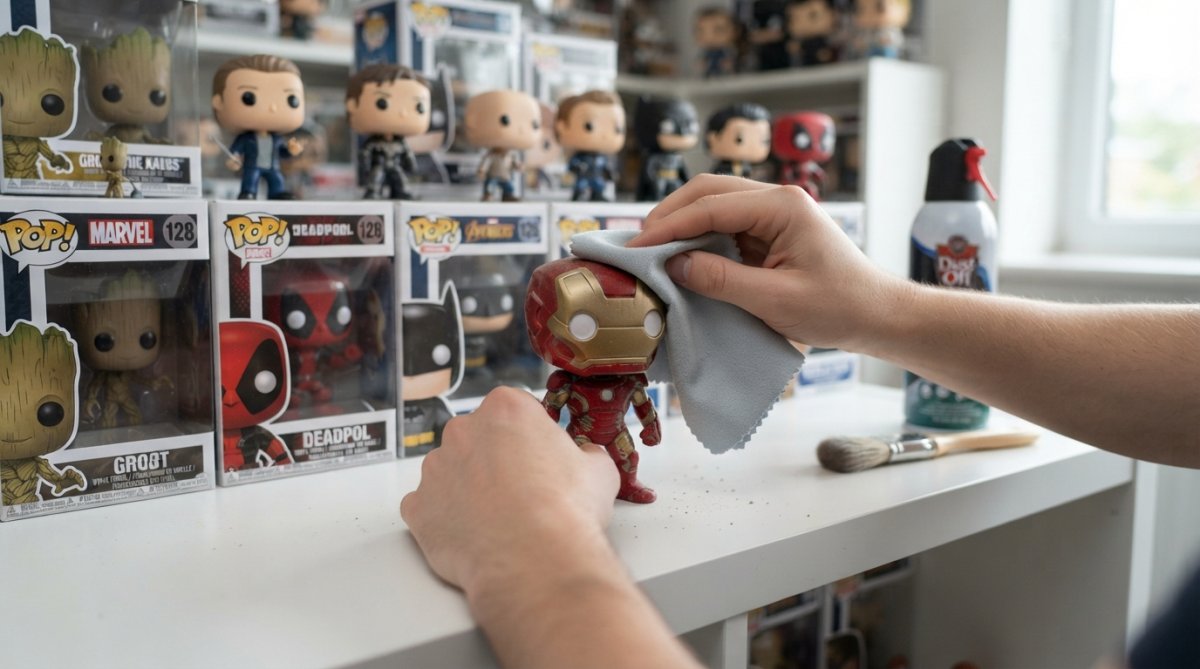
- Remove the figure from its shelf and hold it by the base, never the head or an accessory.
- Give it a short burst of canned air, holding the can upright and about 15 centimetres away.
- Work a dry microfibre cloth over the large flat areas with light pressure.
- Use the soft brush for hair, capes and any sculpted texture.
- Return the figure to a dust-free shelf once fully dry.
Using Canned Air and Microfibre Cloths
Canned air handles loose dust but has limits. Hold the can upright or you'll spray propellant onto the figure, leaving an oily residue that attracts dust. Use short bursts and never let the nozzle touch the vinyl.
Managing Static Electricity on Vinyl
Vinyl attracts dust through static electricity, especially in dry indoor air. A figure gathering dust faster than its neighbours usually carries a static charge, not a dustier spot.
Best Tools for Cleaning Pop Vinyls
The best tools for cleaning Pop Vinyls are a microfibre cloth, soft-bristled brush, canned air and isopropyl alcohol, used in that order of escalation. You don't need a specialist kit, and the right tool depends on the finish, not just the job.
| Tool | Best For | Avoid On |
|---|---|---|
| Microfibre cloth | Routine dusting, large flat areas | Wet use on flocked figures |
| Soft-bristled brush | Hair, capes, sculpted detail | Stiff bristles on metallic finish |
| Canned air | Crevices, accessories | Angled use near loose parts |
| Isopropyl alcohol | Sticker residue, stubborn marks | Flocked and painted faces |
| Cotton swabs | Eyes, fine detail, seams | Rubbing hard on matte paint |
| Distilled water | Acrylic cases, damp-cloth work | Cardboard boxes |
| Cotton gloves | Handling metallic and chrome finishes | Gripping flocked surfaces |
Matching the Tool to the Finish
A matte vinyl figure tolerates the full ladder: air, dry microfibre, a barely damp cloth, then isopropyl alcohol on a swab. The finish changes where it stops.
How to Remove Scuffs from Pop Vinyls
Most scuffs on a Pop! Vinyl sit on the surface, not in the paint, so they lift with patience. Start with a damp cloth and a drop of mild soap, then escalate to isopropyl alcohol on a cotton swab.
Sticker Residue and Stubborn Marks
Sticker residue is the most common stubborn mark and the easiest to fix if you don't rush. Dampen a cotton swab with isopropyl alcohol, let it sit a few seconds, then wipe, the adhesive lifts rather than smears.
Maintaining Pop Vinyl Box Condition
Box condition matters as much as the figure, and cardboard is far less forgiving than vinyl. Dust with a dry, lint-free cloth and keep it out of direct light, sunlight fades print and weakens card.
Cleaning Acrylic Display Cases vs Cardboard Boxes
Acrylic cases and cardboard boxes need different methods. Acrylic scratches easily and holds static, so use microfibre with a little distilled water, never a dry paper towel, and a plastic-safe cleaner to avoid clouding.
Handling Vaulted, Flocked and Metallic Figures
Vaulted, flocked and metallic figures need gentler handling than a standard release. A vaulted figure can't be replaced at retail, so treat every vaulted piece as if it's the only one you'll ever own.
Flocked Figures
Flocked figures have a fuzzy surface that traps dust and holds moisture. Never use a damp cloth or alcohol, both mat the fibres permanently. Canned air and a soft brush are the only safe tools; store them away from humidity.
A few specifics that matter:
- Brush with the nap, not against it. Working against the grain lifts fibres and leaves a rough patch.
- Hold the can of air well back and use short bursts. A long blast at close range can drive dust deeper into the flock.
- Store flocked figures with a silica gel sachet in the display area if your home runs humid. Replace the sachet when the indicator changes.
- Never stack flocked figures against each other. Contact between two flocked surfaces rubs the fibres flat.
Metallic and Chrome Finishes
Metallic figures show every fingerprint and smear. Handle with clean hands or cotton gloves and buff only with a dry microfibre cloth, solvents strip the sheen permanently.
Glow-in-the-Dark Figures
Glow-in-the-dark vinyl is a phosphorescent pigment mixed through the material, so it behaves like standard vinyl but ages differently. It yellows faster under UV, and once the pigment fades the glow is permanently weaker. Keep them out of direct sunlight and clean with the standard matte routine.
Vaulted and High-Value Pieces
For any high-value or vaulted piece, a protective casing keeps dust off entirely and removes the need for regular cleaning, the cheapest insurance a collector can buy. Two rules:
- Keep the original box and insert even if you display the figure out of box. For vaulted items, the box is a significant part of the resale value and can't be replaced.
- Handle vaulted figures over a soft surface, not over a hard floor. A drop from shelf height onto tiles is the most common way a vaulted piece is destroyed, and it happens during cleaning, not display.
A Note on Counterfeits
Vaulted and rare figures attract counterfeits, and a counterfeit won't behave like genuine vinyl under cleaning. Paint lifts more easily, flocking sheds, and metallic finishes flake. If a figure's finish reacts unusually to a routine clean, that's worth investigating before you treat it as damage. the Australian Competition and Consumer Commission's guidance on product safety and authenticity is a useful starting point for spotting counterfeit goods.
Restoring Yellowed Plastic and Preventing UV Damage
Yellowing on clear plastic and pale vinyl comes from UV exposure and oxidation, the most common age-related damage collectors face. Mild yellowing on removable clear plastic, like a display window or case, can often be reversed.
Common Mistakes That Damage Your Collection
The mistakes that damage a collection are almost always about being too aggressive, too wet, or too impatient. The most common:
- Using paper towel or tissues: leaves micro-scratches on paint. Use microfibre only.
- Spraying alcohol directly on a figure: runs into joints and seams. Apply to a cloth or swab first.
- Soaking a figure to loosen grime: moisture causes long-term damage. Use a barely damp cloth.
- Cleaning flocked figures with liquid: mats the fibres permanently. Use air and a dry brush.
- Storing figures in direct sunlight: causes yellowing and fading. Use UV-filtered storage.
- Stacking heavy boxes: crushes corners and drops value. Store upright with nothing on top.
- Handling metallic figures with bare hands: leaves fingerprints that etch over time. Use cotton gloves.
Frequently Asked Questions
Are Pop! Vinyls washable in water?
Submerging Pop! Vinyls in water is not recommended. Water can seep into joints, loosen paint and cause moisture damage that leads to mould or warping over time. Instead, use a barely damp cloth for surface grime and dry immediately with a lint-free cloth. For deeper cleaning, stick to isopropyl alcohol on a cotton swab for small spots only. Keeping your figures dry is the safest way to maintain mint condition.
What are the best tools for cleaning pop vinyls without damaging the paint?
A microfibre cloth, soft makeup brush, canned air and cotton swabs cover most cleaning needs. For stubborn marks, use a small amount of rubbing alcohol on a cotton swab, never directly on the figure. Avoid paper towels, abrasive sponges and household cleaners, which can scratch surfaces or strip paint. A dryer sheet can help reduce static electricity that attracts dust between cleanings.
How do I clean a damaged or dusty Pop! Vinyl box?
For cardboard packaging, use a soft dry brush or microfibre cloth to lift dust from the surface. Avoid damp cloths, which can warp cardboard and lift print. For acrylic display cases, a damp microfibre cloth with mild soap works well, followed by thorough drying to prevent streaks. If the box has sticker residue, apply gentle heat from a hairdryer and peel slowly, then wipe with a small amount of rubbing alcohol.
Can I remove scuffs and sticker residue from my Pop! Vinyls?
Light scuffs often lift with a pencil eraser or a microfibre cloth and a tiny amount of rubbing alcohol. For sticker residue, warm the adhesive with a hairdryer on low, peel slowly and wipe the remaining tack with isopropyl alcohol on a cotton swab. Test on a hidden area first, especially on flocked or metallic finish figures where paint adhesion varies. Never scrub hard, as this can dull the surface permanently.
