

Table of Contents
- Start With a Plan: Assess Your Collection and Space
- Pop Vinyl Shelves: Wall-Mounted, Floating, and Ledges
- Pop Vinyl Display Cases: Acrylic, Clear, and Protective Options
- How to Organise a Funko Pop Collection by Theme and Series
- In the Box or Out: Choosing Your Display Style
- Small Space Collectible Display Ideas That Work
- Protect Your Figures: Light, Heat, Dust, and Long-Term Care
- Conclusion
- Frequently Asked Questions
Last Updated: October 20, 2026
Start With a Plan: Assess Your Collection and Space
Learning how to display Pop Vinyl starts with two numbers: how many figures you own, and how much usable space you have. Get those wrong and every shelf you buy becomes a compromise. At Pop Pelican, we have over 20 years of industry experience.
Measure Before You Buy
Grab a tape measure and write down three things for every wall you are considering:
- Width between the nearest door frame, window or corner
- Height from skirting board to ceiling
- Depth you can afford to lose from the room
A standard Pop Vinyl box is roughly 9 cm wide, 11.5 cm deep and 16 cm tall. Out-of-box figures sit a little shorter. Multiply those figures by your collection size and you have a realistic footprint before you spend a cent.
Sort by Priority and Rotate
Not every figure deserves prime position. Split your collection into three groups:
- Heroes - grails, signed pieces, limited editions. These go at eye level.
- Series sets - complete runs that look best grouped together.
- The rest - duplicates, impulse buys, figures you could live without on show.
Rotate the third group every few months. It keeps the display fresh and stops shelves from overflowing.
Pop Vinyl Shelves: Wall-Mounted, Floating, and Ledges
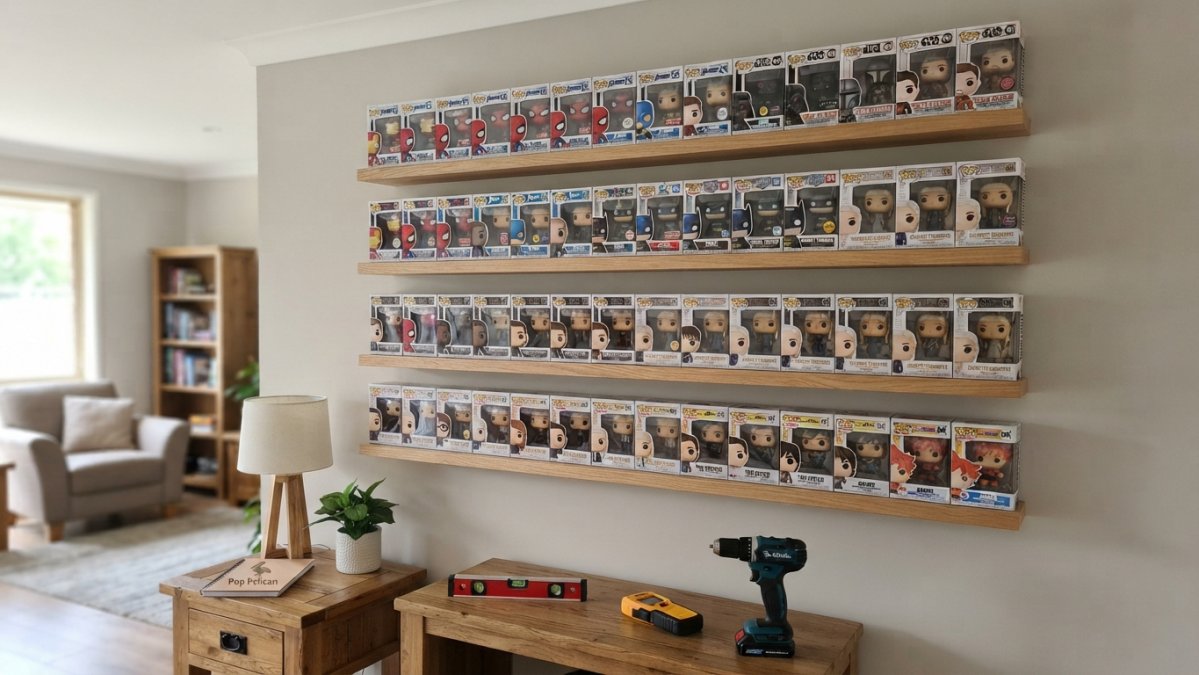
Wall-mounted shelving is the single best way to free up floor space and turn a collection into a feature. Floating shelves give the cleanest look because there are no visible brackets, while ledges suit lighter loads and renters who cannot drill large holes.
Three shelf types do most of the work:
- Floating shelves - hidden fixings, sleek finish, best for a tidy run of figures
- Wall ledges - a shallow lip holds boxed figures upright, ideal above a desk
- Corner shelving - turns dead space into display space in small rooms
Plan the Run Before You Drill
Most display guides stop at "buy a shelf". The difference between a display that lasts and one that sags is the planning done before the first hole. Work through this sequence:
- Mark the full run on the wall in pencil. Use a spirit level to draw a horizontal line at your chosen height, then mark each shelf's start and end. Check the line against the ceiling and skirting so the run looks intentional rather than drifting.
- Set vertical spacing. Space shelves 20 to 25 cm apart to clear a boxed figure with room to reach in and dust. If you display out of box, 15 to 18 cm is often enough. Keep the bottom shelf at least 30 cm above the skirting so a vacuum head can reach underneath.
- Find the studs. Run a stud finder across the wall and mark each stud with painter's tape. Studs are typically spaced at regular centres in timber-framed walls; in masonry, you will be anchoring into brick or concrete instead. Never assume, confirm with a finder before drilling.
- Choose fixings to match the wall and the load. Into studs, use structural screws long enough to bite well into the timber. Into plasterboard with no stud behind, use rated hollow-wall anchors, not the light picture-hanging hooks. Into brick or concrete, use masonry anchors or sleeve anchors. The fixing, not the shelf, is usually the weak point.
- Drill, level, and test. Fit the brackets or hidden cleats, offer the shelf up, check level again, then load it gradually. Give a new shelf a light press before adding figures to confirm it is solid.
Weight Limits and Wall Safety
This is the part most display guides skip. A shelf loaded with boxed figures is heavier than it looks, and a failed fixing means broken collectables and a damaged wall.
Follow these rules:
- Fix into studs or use rated masonry anchors. Plasterboard alone will not hold a loaded shelf.
- Check the shelf's stated load rating and stay well under it. A common pattern is to keep loaded weight to roughly half the rated capacity so there is headroom for the occasional lean or bump.
- Distribute weight evenly rather than stacking one end. Spread heavy boxed sets across the run and keep the heaviest items nearest the fixings.
If you rent, use adhesive-backed ledges rated for light loads or freestanding units. Never guess at a wall's structure. If in doubt, ask your building manager or a qualified tradesperson, a licensed handyperson can confirm what is behind the plaster and specify the right anchor.
Pop Vinyl Display Cases: Acrylic, Clear, and Protective Options
Acrylic display cases solve the dust problem and make small collections look deliberate. Clear cases let you see the figure from every angle while keeping fingers and sunlight off the paint.
A few options worth knowing:
- Individual acrylic cases for grails and signed pieces
- Multi-tier clear cases that stack figures in rows
- Hard acrylic box-style cases that mimic the look of a boxed figure
Bitty Pop! sets are a good example of built-in protection. The Stranger Things Byers House Bitty Box Playset arrives in a hard acrylic case modelled on a Pop! box, and the detachable lid doubles as a base.

How to Organise a Funko Pop Collection by Theme and Series
Grouping is what separates a display pop vinyl setup from a pile. Decide on one organising rule and stick to it, because mixing rules creates visual noise.
The four rules that work best:
Stranger Things - Byers House Bitty Box Playset (Pop! Vinyl) 16cm × 12cm × 9cm →
- By franchise - all Star Wars together, all Marvel together
- By series number - satisfying for completionists chasing a full run
- By colour or character - bold, graphic, great for a feature wall
Once grouped, arrange each shelf with the tallest figures at the back and smallest at the front. That gives depth without hiding anything.
In the Box or Out: Choosing Your Display Style
Boxed figures hold value and protect paint, but they eat space and hide detail.
Our honest take: display your heroes out of the box in acrylic cases and keep the rest boxed. You get the visual impact where it matters and the protection everywhere else.
If you go out-of-box, keep the boxes stored flat and dry. They matter if you ever sell or move.
Small Space Collectible Display Ideas That Work
Small rooms reward vertical thinking. A narrow wall can hold more than a wide floor.
Try these:
- Above-door ledges for boxed figures
- Corner shelving to use dead angles
- A single tall bookcase with adjustable shelves
Bitty Pop! figures are ideal here. The Sonic 2 Diorama Bitty Pop! Playset folds open into a scene and closes into a compact case, so it displays beautifully and stores small.

Protect Your Figures: Light, Heat, Dust, and Long-Term Care
Sunlight is the quiet killer of vinyl collections. UV exposure fades paint and yellows clear plastic over time, and the damage is cumulative, a figure that looks fine after a month on a sunny sill can be visibly changed after a year. Heat and humidity do their own slow work, softening vinyl, warping boxes and encouraging mould in stored collections.
Understand What Actually Causes Damage
- UV light breaks down pigments and clears plastics. Direct sun through a window is the worst offender, but prolonged bright indirect light also contributes.
- Heat softens vinyl and can distort figures that are leaning or packed tightly. Heaters, lamps and sunny windows are the usual sources.
- Humidity and damp warp cardboard boxes, lift print and create conditions for mould. Rooms with poor airflow or walls that stay cold and wet are the risk zones.
Place Displays to Avoid the Risks
- Keep displays out of direct sun. If a wall catches strong afternoon light, fit a sheer blind or UV-filtering film on the glass rather than moving the whole collection.
- Keep shelves away from heaters, radiators and lamps that run hot. A gap of at least a metre from a heat source is a sensible starting point.
- Avoid damp rooms and wet walls. A wall that feels cold or shows paint blistering is telling you something.
- Rotate sun-exposed pieces every few months so no single figure takes the full dose.
Build a Simple Care Routine
- Dust monthly with a soft microfibre cloth. For boxed figures, dust the box faces rather than the plastic window, which scratches easily.
- Keep humidity steady, avoid damp rooms and wet walls, and don't store collections against an exterior wall that stays cold.
- Use acrylic cases to cut dust and handling. Cases also buffer small temperature swings.
- Handle figures by the base, not the head or paint, and wash hands first.
Store Spares Properly
Store spare figures in a cool, dry cupboard, not a garage or shed where temperatures swing hard. Keep boxes flat and dry, ideally in archival or acid-free storage if you plan to keep them long term. Stack boxes so the weight is carried by the strongest panels, and avoid compressing the plastic windows. If you live in a humid climate, a moisture absorber in the storage cupboard is a cheap safeguard.
Conclusion
Building a display that lasts comes down to planning, safe fixing and steady care. The collectors who get it right measure first, fix shelves properly and protect their figures from light and dust.
At Pop Pelican, we stock Australia's largest range of officially licensed Pop! Start with a Bitty Pop! Ride like the Star Wars Speeder with Luke or the Avengers Doomsday Lord Doom Bitty Pop! Town, and build your display one shelf at a time.

Frequently Asked Questions
How do I display my Funko Pop collection without damaging the figures?
Keep figures out of direct sunlight, because UV exposure fades paint and yellows plastic over time. Position shelves away from windows and heat sources such as heaters and direct afternoon sun. Use acrylic display cases for your most valuable pieces to block dust and limit light exposure. When mounting shelves, check the wall fixing is rated for the combined weight of the shelf and figures, and keep heavier pieces on lower shelves. Dust gently with a soft microfibre cloth rather than household cleaners, which can cloud clear plastic.
Should I display Pop Vinyl figures in or out of the box?
It depends on what you value. Boxed display protects figures from dust and light and keeps the packaging intact, which matters if you may resell later. Out-of-box display lets you see the sculpt and paint detail and makes themed arrangements easier. A common compromise is displaying your favourite figures out of box on shelves and storing the rest boxed in archival-safe containers. Whichever you choose, keep boxes away from damp areas, because cardboard absorbs moisture and warps.
How can I arrange Pop Vinyls in a small space?
Use vertical space first. Wall-mounted shelves, narrow ledges, and corner shelving add display area without taking up floor space. Rotate your collection seasonally so only part is on show at once, and store the rest safely. Acrylic risers let you stack two or three rows on a single shelf. For renters, adhesive-backed ledges and freestanding shelving units avoid drilling. Keep the arrangement grouped by character or series so a small display still looks deliberate rather than cluttered.
What are the best display options for Pop Vinyl shelves and cases?
Floating shelves suit large collections and let you arrange figures by series across a wall. Wall ledges work well for a single row in narrow spaces. Acrylic display cases protect individual figures from dust and handling, and hard acrylic cases with detachable bases are useful for smaller Bitty Pop! figures and playsets. For a mix of both, use shelves for everyday display and cases for rare or limited-edition pieces. Check shelf weight ratings and fixings before loading them up.


