

Last Updated: October 30, 2026
Quick Summary
The best lighting for pop culture collectibles is low-heat LED with a diffused cover, set at neutral white around 3500K to 4000K with a CRI of 90 or above. Angle it from above and slightly to the front so it avoids glare, and keep it dimmable to protect light-sensitive pieces.
- Choose LED over halogen or older bulbs, since LEDs run cooler and emit very little UV.
- Pick a diffused or frosted cover to soften hot spots on glossy vinyl and glass.
- Aim for neutral white between 3500K and 4000K for a balanced look across a mixed shelf.
- Look for a CRI of 90 or above so painted colours read close to daylight.
- Keep light-sensitive comics, cards and signed packaging on a dimmed circuit at low brightness.
Table of Contents
- Why Lighting Matters for Pop Culture Collectibles
- Choosing LED Lights for Display Cabinets
- Picking the Right Colour Temperature for Display Lighting
- How to Reduce Glare in Display Cabinets
- Action Figure Display Lighting: Placement and Setup
- Lighting Glow-in-the-Dark and Blacklight Pieces
- Setting Up Your Lit Display at Home
- Frequently Asked Questions
Lighting can make a pop culture collectible look spectacular, but the wrong setup can also fade paint, warp packaging and leave hot spots that flatten the figure. The aim is a display that shows off every detail without glare or heat damage. This guide covers the lighting choices that matter most for Pop! Vinyls, action figures and die-cast models, so you can set up a display that looks good and protects your collection.
Why Lighting Matters for Pop Culture Collectibles
Lighting does two jobs at once. It makes a display visible and attractive, and it quietly affects the condition of what sits inside it. Bright, directional light picks out sculpt detail and paint work, which is why collectors light their shelves at all.
A glow-in-the-dark figure is a good example. Its charge comes from ambient light, so a display light placed close to it can make it look dim by comparison. Blacklight pieces need a different approach entirely.
Choosing LED Lights for Display Cabinets
LED lighting is the practical default for display cabinets because it produces little heat and uses little power. The main decision is not whether to use LED but which format suits your cabinet, because strips, puck lights, bar lights and spot fittings behave very differently once they are inside glass.
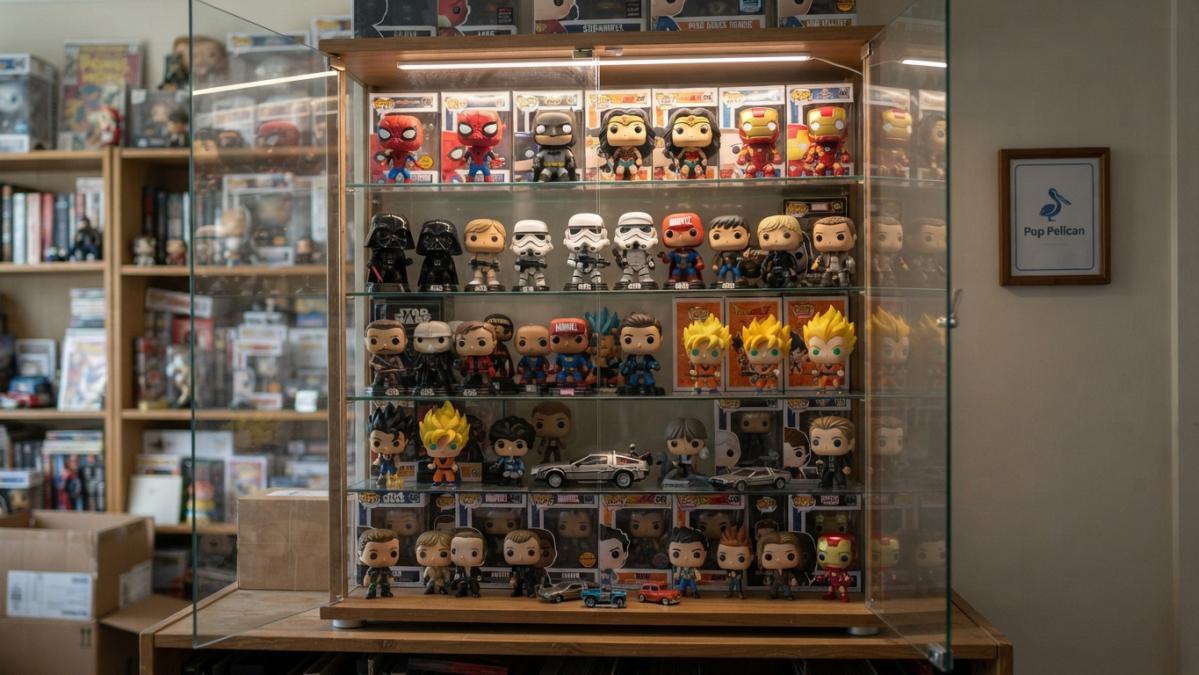
The four formats worth comparing
- Adhesive LED strips. Best for long shelves and continuous under-shelf runs. Look for a strip with a diffusing cover rather than bare diodes, because bare diodes show as bright points reflected in glass and glossy packaging. Check the cut points and the connector type before buying, since a strip that cannot be cut to length will either overhang the shelf or leave a dark end.
- Puck lights. Small round fittings that suit a single shelf or a focal figure. They are easy to reposition but cast a narrow pool of light, so a row of figures usually needs two or three pucks rather than one.
- Bar lights. Rigid aluminium bars that spread light more evenly than pucks and mount cleanly along the top or back of a cabinet. They cost more than strips but avoid the sagging and peeling that adhesive strips suffer over time.
Specifications that actually matter
When comparing LED options, check these before price:
- Coverage and length. Measure the internal shelf width and depth, then choose a strip or bar that covers at least 80 per cent of the shelf. A light that stops short leaves the end figures in shadow.
- Dimming. A dimmable fitting lets you drop brightness at night without changing the colour. Look for a dimmer that works with the driver supplied, because mixing brands often causes flicker.
- Colour temperature range. A tunable white fitting (roughly 2700K to 5000K) lets you warm the display for older pieces and neutralise it for modern paintwork.
Mounting and cable management
Mount strips and bars at the front edge of the shelf, angled slightly back toward the figures, so the light falls across the faces rather than straight down the glass. Run cables along the back corner of the cabinet and secure them with clips so they do not cross the display. Keep the driver and power supply accessible but out of sight, and leave a small gap around the driver for ventilation.
Matching the light to what you collect
Different collectibles need different treatment. Glossy vinyl figures and painted statues benefit from diffused light that softens highlights, while die-cast models and signed packaging need lower brightness to avoid glare off reflective surfaces. Comics, cards and signed memorabilia are the most light-sensitive, so keep them on a dimmed circuit or away from the brightest part of the cabinet.
The four LED formats differ in how they behave inside a cabinet, so the table below sets them side by side.
| Format | Best for | Key difference |
|---|---|---|
| Adhesive LED strips | Long shelves, under-shelf runs | Choose a diffused cover to avoid reflections |
| Puck lights | A single shelf or focal figure | Narrow pool of light; often needs two or three |
| Bar lights | Even light along top or back | Rigid and costlier, avoids sagging and peeling |
| Spot and track fittings | One centrepiece | Concentrates heat and glare; keep at a distance |
Picking the Right Colour Temperature for Display Lighting
Colour temperature, measured in Kelvin (K), changes how a figure looks, and colour rendering, measured by the colour rendering index (CRI), changes how accurately it looks. Most collectors focus on Kelvin and ignore CRI, which is why so many lit displays look slightly wrong even when the brightness is right.
What each range does
- Warm white, around 2700K to 3000K. A soft, cosy tone that flatters Pop! Vinyls, older-style collectibles and wooden shelving. It can make modern paintwork look slightly yellow.
- Neutral white, around 3500K to 4000K. The balanced middle ground and the safest default for a mixed collection. Skin tones and primary colours read close to how they look in daylight.
- Cool white, above 5000K. Crisp and bright, but it pushes colours toward blue and can make reds and oranges look flat. It suits technical models and metallic finishes better than painted figures.
For most collectors, a neutral white between 3500K and 4000K gives a balanced result across a mixed shelf. If your collection is mostly older or warm-toned pieces, drop toward 3000K; if it is mostly modern figures with strong primary colours, 4000K is usually closer.
Why CRI matters more than most buyers realise
CRI runs on a scale where 100 represents natural daylight. A fitting rated around 90 CRI or above shows colours close to how they appear in daylight, while a cheap fitting rated in the low 80s or below can make a bright red figure look muddy and a pale figure look grey. For a display where colour accuracy is the whole point, treat 90 CRI as the practical minimum and check the rating on the packaging rather than assuming a higher price means a higher CRI.
Brightness guidance
Brightness is measured in lumens, and more is not better. A shelf of figures usually reads well at a modest level, roughly a few hundred lumens spread across the shelf, because too much light flattens sculpt detail and increases glare. Dimming is more useful than raw output: choose a fitting that can run at part power so you can tune it to the room.
Matching colour temperature to collectible type
- Painted figures and statues. Neutral white at 3500K to 4000K with high CRI, so paintwork reads true.
- Die-cast models and metallic finishes. Slightly cooler light can bring out metallic sheen, but avoid going so cool that colours shift.
- Comics, cards and signed memorabilia. Warm to neutral light at low brightness, kept short in duration, because these materials are the most prone to fading.
How to Reduce Glare in Display Cabinets
Glare is the most common complaint in lit displays. It comes from light hitting glossy vinyl and glass at the wrong angle, creating white hot spots that wash out the figure. Three simple adjustments help the most.
- Angle the light from above and slightly to the front, not straight down the glass.
- Use diffused or frosted LED covers to soften the output.
- Keep the light source out of the direct line of sight when you stand in front of the cabinet.
Glass also reflects the room behind you. Dimming the room lights, or placing the cabinet away from a window, reduces the reflection so the figures stand out.
The Batman - Batmobile With Batman 1:18 Scale Hollywood Ride With Light →
Action Figure Display Lighting: Placement and Setup
Good placement matters more than expensive hardware. Start by deciding which figure you want to highlight, then position the light to give it a clean main light and soft fill. Front-and-above lighting usually shows the face and chest detail best.
Keep figures at a comfortable distance from the light source, usually at least 15 to 20 centimetres for LED strips, so the surface does not heat up.
For those choosing which figures suit a desk display, our guide on best action figures for desk display covers sizes and finishes that work well under a small light. If you are weighing up overall display methods, the best way to display action figures explains the common setups in more depth.
Protecting Figures From UV and Heat
UV light is the quiet threat. Sunlight and some household bulbs emit UV that fades paint and yellows clear packaging over time. Heat compounds the damage by softening some plastics and speeding up fading. Several habits reduce both risks.
- Keep figures out of direct sunlight, including sun through a window.
- Choose LED lighting over halogen or older incandescent bulbs, since LEDs run cooler and emit very little UV.
- Use UV-filtering acrylic or glass on the cabinet front if the display sits near a window.
Rare and limited figures deserve extra care. For a fuller plan on protecting high-value pieces, how to protect rare action figures covers storage and display precautions in detail. Humidity also affects packaging and cardboard, so see how to safely store pop vinyls in humid weather if your collection is kept somewhere damp.
Lighting Glow-in-the-Dark and Blacklight Pieces
Glow-in-the-dark figures need light to charge before they glow. Expose them to a bright LED or daylight for a few minutes, then move them into the dark to see the effect.
Blacklight pieces such as the Dia de Los Muertos - La Catrina (Azul) Exclusive Blacklight Pop! Vinyl respond to blacklight, usually supplied as a blacklight bulb or torch.
Glow-in-the-dark figures such as the Star Wars: Across the Galaxy - Force Ghost Glow 3 Pack and the My Hero Academia - Tenya Recipro Blast Glow glow in the dark. Charging them with a light first lets the glow show when the room lights go off.
Setting Up Your Lit Display at Home
Start with a clear plan. Measure the cabinet or shelf, decide which pieces will be the focal point, and choose a light that covers the whole display without hotspots.
A simple setup order works well. For a broader plan covering shelving, room placement and ways to show off a larger collection, how to display Pop! Vinyls walks through the full process.
The Batman - Batmobile With Batman 1:18 Scale Hollywood Ride With Light (Model Car), priced at $59.95, is a useful centrepiece for a display with lighting because it includes a light feature.
Browse the collection at Pop Pelican's range of officially licensed collectibles and build a display that looks good and stays in good condition for years to come.
Frequently Asked Questions
What is the best lighting for displaying collectibles?
LED lighting is the most practical choice for most collectors. It produces little heat, uses low power and comes in strips, puck lights and battery-operated units that suit most cabinets and shelves. Choose a neutral to warm white, aim the light at the figures rather than the glass, and test a few options in your own space before committing to a full setup. Battery-operated lights are useful for shelves without a nearby power point, though they need checking regularly.
Are LED lights safe for action figures and collectables?
Yes, LED lights are generally considered safe for action figures and collectables because they run cool compared with older halogen bulbs. Keep the LED source at a distance from the figure, avoid leaving lights switched on for many hours a day, and make sure any wiring is secured away from the figures. Always use lights rated for the power supply you are plugging into, and check product instructions for installation and safety.
Can sunlight damage action figures and display boxes?
Yes. Direct sunlight, and to a lesser extent the UV found in some artificial light, can fade paint, yellow plastic and weaken card packaging over time. Keep collectibles out of direct sun, consider UV-filtering glass or acrylic on cabinets, and avoid placing displays in front of a sunny window. Rotating or limiting how long a piece is lit each day also helps protect it.
What colour temperature is best for a collectibles display?
A warm white around 2700K to 3000K tends to flatter painted figures and vintage-style packaging, while a neutral white around 4000K shows true colours more accurately for modern, bright pieces. Glow-in-the-dark and blacklight pieces need their own consideration, since their effect depends on the light source rather than the colour temperature. Test a few options side by side on your actual collection before choosing one for the whole cabinet.


